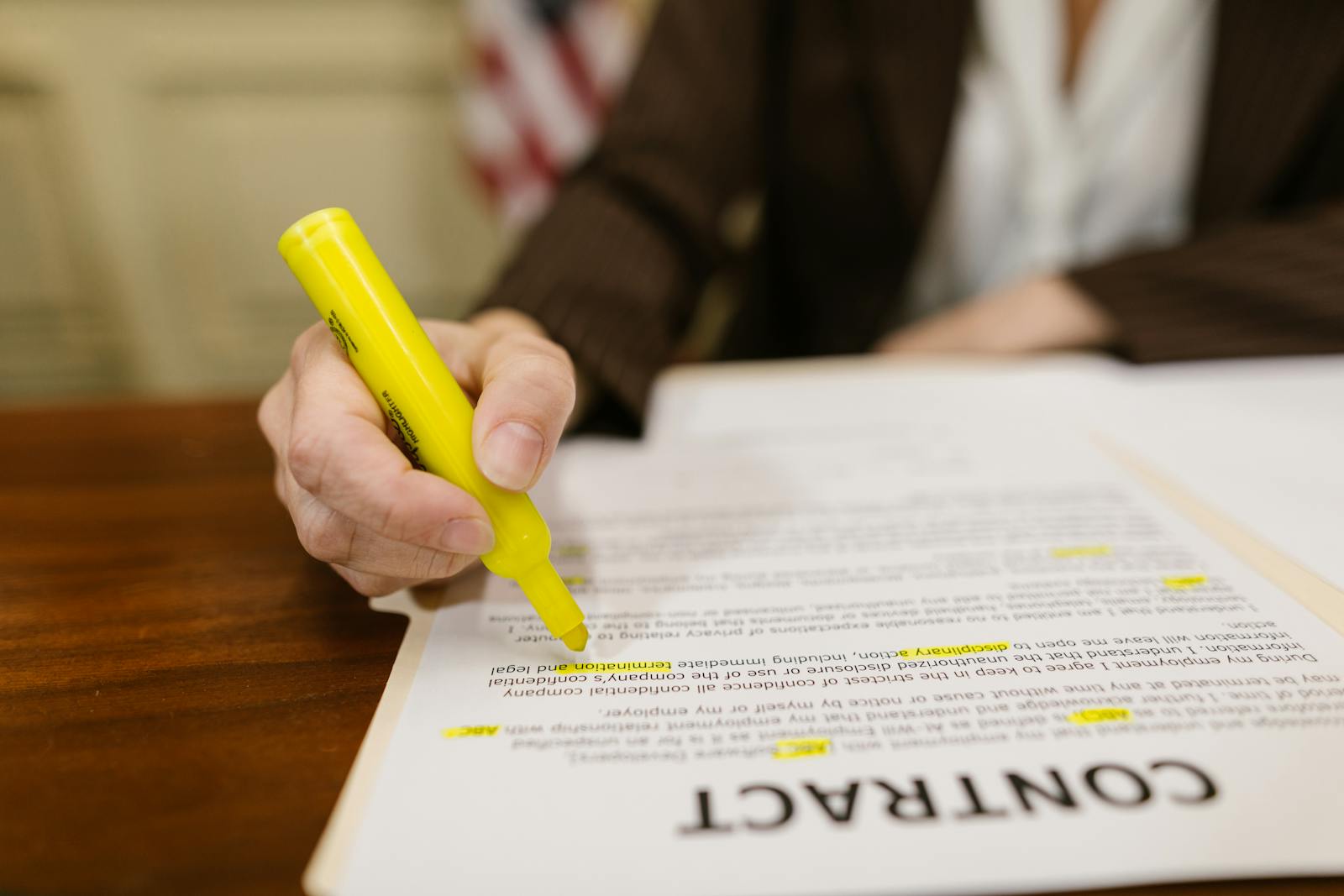
A supplier contract that lets the supplier raise prices on two days' notice, while you are locked in for three years, could now cost the supplier up to $50 million. Since 9 November 2023, unfair contract terms in standard form contracts with small businesses and consumers have been illegal under the Australian Consumer Law, not merely unenforceable. The protection covers any small business with fewer than 100 employees or annual turnover under $10 million.
The main points
| Question | Answer |
|---|---|
| Who is protected? | Consumers, and businesses with fewer than 100 employees or turnover under $10 million |
| Which contracts? | Standard form contracts, regardless of value |
| What is an unfair term? | One causing significant imbalance, not reasonably necessary, and causing detriment |
| What is excluded? | Upfront price, main subject matter, terms required by law |
| Penalty for companies | Greatest of $50 million, 3 times the benefit, or 30% of adjusted turnover |
| Penalty for individuals | Up to $2.5 million |
| Regulators | ACCC and state fair trading (ACL), ASIC (financial services) |
Who counts as a small business?
The test is simple: at the time the contract is made, the business has fewer than 100 employees, or its turnover for the last income year was under $10 million. Only one limb needs to be met, according to the ACCC.
Employees include casuals employed on a regular and systematic basis, but not staff of related companies. A 120 person labour hire firm with $8 million turnover is protected because of its turnover, while a 40 person engineering consultancy turning over $25 million is protected because of its headcount.
Before the 2023 reforms, the law covered only businesses with fewer than 20 employees and contracts worth under $300,000, or $1 million for contracts longer than 12 months. Those value caps have gone.
Consumers are protected too. An individual buying goods or services wholly or mainly for personal, domestic or household use gets the same protection from unfair terms in standard form contracts, which is why gym memberships, phone plans and streaming subscriptions often feature in regulator cases.

What makes a contract standard form?
There is no fixed definition, and the business that drafted the contract must prove it is not standard form if challenged. Courts look at factors such as whether one party had all or most of the bargaining power, whether the contract was prepared before any discussion, and whether the other side had a real chance to negotiate.
The 2023 changes closed common loopholes. A contract can still be standard form if the small business negotiated minor or insubstantial changes, selected terms from a menu of options, or negotiated terms of a separate related contract, as the NSW Government explains.
Typical standard form contracts for small businesses include:
- Supplier terms of trade and credit applications
- Software, telco and payment processing agreements
- Franchise agreements and licence agreements
- Equipment leases and commercial leases from large landlords
- Subcontracts issued by head contractors
- Online platform terms for sellers, drivers and service providers
The three part test for unfairness
Under section 24 of the Australian Consumer Law, a term is unfair only if all three limbs are met:
- It would cause a significant imbalance in the parties' rights and obligations under the contract.
- It is not reasonably necessary to protect the legitimate interests of the party who would be advantaged by it.
- It would cause detriment, financial or otherwise, to the other party if relied on.
The second limb carries a presumption. The term is presumed not to be reasonably necessary unless the business relying on it proves otherwise, which puts the burden on the drafter.
Courts consider the contract as a whole and how transparent the term is. A clause written in plain language, highlighted and explained before signing is less likely to be unfair than the same clause buried on page 14 in six point type.

Terms most likely to be unfair
Section 25 of the ACL lists examples of terms that may be unfair. The ACCC's guide for businesses and legal practitioners expands on them, and these are the categories small businesses meet most often.
| Type of term | Example | Why it may be unfair |
|---|---|---|
| One sided variation | Supplier can change prices or terms at any time without notice | Only one party can change the deal |
| One sided termination | Supplier can end the contract at will, customer cannot | Unequal exit rights |
| Penalty for breach | Customer pays a fixed $5,000 fee for any breach | Out of proportion to the loss |
| Liability limits | Supplier excludes liability for its own negligence | Shifts all risk to the customer |
| Broad indemnity | Customer indemnifies supplier for any loss, however caused | Covers losses the customer did not cause |
| Automatic renewal | Contract rolls over for a new term with short notice window | Locks customer in |
| Short claim deadlines | Disputes must be raised within 24 hours or 60 days | Removes rights before the customer can act |
The short claim deadline is not hypothetical. In July 2024 the Federal Court found PayPal's term requiring businesses to raise fee errors within 60 days, or be stuck with the fees, was unfair, as summarised by Attwood Marshall Lawyers.
Where small businesses meet unfair terms
Construction subcontracts
Head contractors often issue the same subcontract to every trade on a project, which makes it standard form for a small electrical or plastering business. Attwood Marshall Lawyers points to terms letting a head contractor take ownership of a subcontractor's tools and equipment, along with price increases without notice and tight claim windows, as the kind of clause now open to challenge.
Franchising
Franchise agreements are drafted by the franchisor and rarely negotiated in substance. They sit alongside the Franchising Code of Conduct, so a franchisee may have rights under both regimes. Clauses worth checking include unilateral changes to the operations manual that add costs, marketing fund levies with no reporting, and restraints that outlast the agreement by years.
Online platforms and software
Sellers, drivers and service providers on digital platforms usually accept terms by clicking a box. The Mable undertaking shows the ACCC is looking at platform terms that deem work approved, impose fixed penalty fees, or let the platform change fees without reasonable notice.
What is not covered?
Three kinds of terms cannot be challenged as unfair under section 26:
- Terms defining the main subject matter of the contract, such as what is being supplied
- Terms setting the upfront price, if disclosed clearly before the contract was made
- Terms required or expressly permitted by a law of the Commonwealth, a state or a territory
Some contracts are also outside the ACL regime. Insurance contracts regulated by the Insurance Contracts Act have their own rules, and financial products and services are covered by the parallel provisions in the ASIC Act.
Penalties and enforcement since 2023
The penalties match those for other serious ACL breaches. For a company, the maximum for each breach is the greatest of $50 million, three times the benefit obtained, or 30% of adjusted turnover during the breach period. Each unfair term in each contract can be a separate breach.
Enforcement has started. In June 2025, the ACCC accepted a court enforceable undertaking from Mable Technologies, an online platform for disability and aged care support, over terms that included a minimum $5,000 penalty fee and timesheets deemed approved unless disputed within 24 hours, according to the ACCC.
In 2026, ASIC obtained a $3.5 million penalty against payday lender CashnGo for unfair terms, as reported in ASIC's media release. The ACCC has also taken Amazon to court over terms it used to introduce ads to Prime Video.

What it means for your business
If you receive a contract
Read the variation, termination, liability, indemnity, renewal and dispute clauses before you sign. Ask the supplier in writing to remove or soften a term you think is unfair, and keep the reply. Even if they refuse, the record shows the contract was not genuinely negotiated.
If you already signed one
An unfair term is void, so the supplier cannot rely on it, but the rest of the contract usually stands. You can raise the issue with the supplier, complain to the ACCC or your state fair trading office, or seek a court order. The Australian Small Business and Family Enterprise Ombudsman can also help with disputes.
If you write the contracts
Many small businesses are themselves the stronger party when dealing with consumers or smaller suppliers. Review your quotes, terms of trade, online terms and subcontracts. Replace one sided rights with mutual ones, add reasonable notice periods, and limit fees to genuine pre estimates of loss.
How to challenge a term, step by step
- Identify the clause and write down why it disadvantages you, with the dollar impact if you can estimate it.
- Check you qualify, by headcount or turnover, at the time the contract was made.
- Write to the other party, quote the clause, explain why you consider it unfair under the Australian Consumer Law and ask them to remove or stop relying on it.
- Keep every reply. A refusal to negotiate supports the argument that the contract is standard form.
- If the issue is not resolved, contact the ASBFEO or your state small business commissioner, which offer low cost dispute resolution.
- Report the term to the ACCC, or ASIC for financial products. Regulators use these reports to choose cases, though they will not act as your lawyer.
- For larger amounts, get legal advice about seeking a court declaration that the term is void, along with any compensation.
Worked example: a cafe's equipment lease
Here is an example. A Newcastle cafe with 14 staff signs a five year coffee machine lease on the supplier's standard terms. The contract lets the supplier increase monthly payments "at its discretion" with 7 days' notice, while the cafe pays out the full remaining term to exit.
- The cafe is a small business, since it has fewer than 100 employees.
- The contract is standard form, offered without real negotiation.
- The price variation clause appears to cause significant imbalance, and the supplier would need to show it is reasonably necessary.
- If a court agreed it was unfair, the clause would be void and the supplier could face a penalty, while the rest of the lease would continue at the original price.
When to get legal advice
Get advice before signing a high value or long term contract, such as a franchise, commercial lease or major supply agreement, and when a supplier tries to rely on a term that seems one sided. Businesses that issue standard form contracts should also have them reviewed, given the penalty exposure. On Sydney's Northern Beaches, commercial lawyers at Chedid Storey review supplier, franchise and leasing contracts for small businesses, and a fixed fee review often costs less than one month of a bad contract.
If you do one thing
If your business has fewer than 100 staff or turns over less than $10 million, the law now protects you from one sided terms in take it or leave it contracts, whatever their value. Check the variation, termination, liability and renewal clauses before signing, keep a record of any negotiation, and if you draft contracts yourself, fix your own terms before a regulator or customer tests them.
Sources
- ACCC, "Contracts", accessed 18 November 2026, https://www.accc.gov.au/business/selling-products-and-services/contracts
- ACCC, "Unfair contract terms: A guide for businesses and legal practitioners", accessed 18 November 2026, https://www.accc.gov.au/system/files/Unfair%20contract%20terms%20-%20A%20guide%20for%20businesses%20and%20legal%20practitioners.pdf
- NSW Government, "Unfair contract terms", accessed 18 November 2026, https://www.nsw.gov.au/legal-and-justice/consumer-rights-and-protection/guarantees-contracts-and-warranties/contracts/unfair-contract-terms
- ACCC, "Disability and aged care support platform amends unfair contract terms", accessed 18 November 2026, https://www.accc.gov.au/media-release/disability-and-aged-care-support-platform-amends-unfair-contract-terms
- ASIC, "26-203MR Court orders CashnGo to pay $3.5 million penalty for unfair contract terms", accessed 18 November 2026, https://www.asic.gov.au/about-asic/news-centre/find-a-media-release/2026-releases/26-203mr-court-orders-cashngo-to-pay-35-million-penalty-for-unfair-contract-terms
- ACCC, "Amazon in court for introducing ads to Prime Video using allegedly unfair contract terms", accessed 18 November 2026, https://www.accc.gov.au/media-release/amazon-in-court-for-introducing-ads-to-prime-video-using-allegedly-unfair-contract-terms
- Attwood Marshall Lawyers, "Unfair contract terms: what businesses need to know, two years on", 25 November 2025, accessed 18 November 2026, https://attwoodmarshall.com.au/new-penalties-for-unfair-contract-terms/
- Small Business Development Corporation WA, "Unfair contract terms", accessed 18 November 2026, https://www.smallbusiness.wa.gov.au/templates-tools-guides/guides/unfair-contract-terms
FAQ
What is a standard form contract?
It is usually a contract prepared by one party and offered on a take it or leave it basis, such as a supplier's terms of trade, a software subscription or a franchise agreement. Since November 2023, a contract can still be standard form even if you negotiated minor changes or chose from preset options.
Does the unfair contract terms law apply to leases?
It can apply to standard form commercial leases where the tenant is a small business. Retail leases are also governed by state retail leasing laws, which give separate protections.
What happens to an unfair term?
A court can declare it void, so it cannot be enforced, and the rest of the contract continues if it can work without that term. The court can also impose penalties, order compensation, or vary or refuse to enforce the contract.
Who enforces the unfair contract terms laws?
The ACCC and state fair trading agencies enforce them under the Australian Consumer Law, and ASIC enforces the parallel rules for financial products and services. Businesses can also take their own action in court.
Can I be the one using unfair terms?
Yes. A small business that uses standard form contracts with other small businesses or consumers is bound by the same law, so check your own quotes, terms of trade and online terms too.
About VLD Business Desk
VLD Business Desk is the VLD editorial byline for business and small business writers. Articles are researched from official and primary sources, which are listed at the end of each piece.


